Showing posts with label chickens. Show all posts

Thursday, November 22, 2012

Keeping chickens

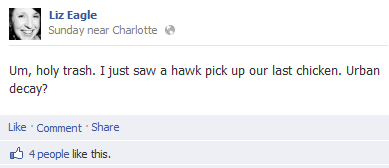
"Keeping" describes exactly what we try to do with chickens. Not that chickens are difficult to care for: they aren't, but they are hard to hold on to. Two weeks ago, I heard an acquaintance lost all of her chickens except the rooster, and I saw this post on my facebook newsfeed this week:
I question why four people "like" this.
Watson does an admirable job keeping hawks away, so we haven't really had too much trouble with predators until this week.

Monday morning about 3 am, the dog must have heard something in the yard.  His whining woke Abe. Fortunately for our chickens, Abe is a light sleeper and got up with a sense that something was amiss. He went outside and sure enough, found a possum had been in the chicken coop.  Friendly (one of our very first chickens and a very sweet Rhode Island Red) had been frightened into a corner, wedged under some pressure washing equipment. That rotten possum had torn her tail feathers and left a serious wound on her (you know what?) chicken butt.

So Abe shot the possum with a BB gun, shushed the other hens and herded them as best he could back to their roost.  It turns out that our kitten-harassin' boot-lickin', chicken-chasin' coon hound loves our hens after all, and I am so thankful for my light-sleepin', BB-gun-shootin', possum-killin', chicken-protectin' husband. I don't even mind how redneck I sound to tell about it.

Friendly seems to be pulling through. So if I can have another moral to this story, it's to raise fat chickens.
  • Fat chickens are harder for hawks to carry.
  • Fat chickens can't easily fly or fit through fences (which, unless you leave the gate open - not that we know anything about that at our house - is how chickens encounter possums in the first place).
  • Fat chickens don't have as many places to hide if they scatter at night and you have to search the yard in the cold looking for them.
  • By the way, having a fat kitty has most of the same advantages. Get one!

Friday, May 4, 2012

Chicken sexing

While we were away, our pullets grew exponentially.  The largest is possibly now the size of all the chickens we saw in Haiti combined (which may hint something about wheat-based diets and obesity problems).


Our young chickens ate their way through the bag of feed Abe left and by the eleventh day, they were looking for more. We got back from Haiti on a Monday at 7:30 am, and we were running to the feed store by 10:30.

Like adolescent boys, growing roosters will eat you out of coop and home... not that we're trying to raise roosters. When we bought our chicks, a crusty old man - wearing crustier overalls -  sexed them to make sure we chose only hens. I knew that sexing chickens is notoriously difficult (never saw myself saying that in public), but our man turned out to be exceptionally incompetent.  Out of 11 chicks, 4 are increasingly rooster-like, making him wrong nearly half the time, almost as often as I am). This week I've heard several early attempts at crowing, so we'll be having coq au vin real soon.

I have mixed feelings about the codes that strictly forbid roosters within the city limits of Charlotte.  On the one hand, our young man-birds are growing more handsome by the day, and I know a rooster would be a great addition to our flock. But on the other, I'm grateful that none of our neighbors are permitted a yard full of birds who announce the arrival of the sun or potential predators loudly and at all hours.

Tuesday, March 20, 2012

Get chickens. A poultry perspective.

Get chickens. Part Two, part two: Think outside the coop.

I amazed even myself by how much I could possibly find to say about preparing a chicken coop, so welcome to part two of Part Two.  I rewrote a classic children's song while on my break to get you jazzed about another chicken post.

Farmer Abe built a home
where our pullets can roam
where our rabbits used to dig and play
Where seldom is heard
Anything but a bird
And they're sheltered
From all of the rain.*


(See the rabbit ghost?  Originally Abe put this together as a home for the rabbits we raised. You'd be haunting your hutch, too, if you were fattened up, killed for food, and stuffed in someone's freezer.)

Even a tiny urban farm is an overwhelming amount of work, so we do things the lazy way whenever we can.  To make this enclosure for our Very Important Pullets, we stapled chicken fencing to door frames that were discarded by a local homeowners association. We covered the whole area with netting to keep out the hawks and owls, and covered part of the run with a tarp to keep out the rain. (This is why we couldn't ever live in a neighborhood with an HOA. HOA's: collecting fees to ensure your neighbors aren't as ghetto as we are.)

There's another run bordering the pullet's - so back fence here also serves as a front fence for our grown hens. (I told you: the lazy way).  Letting the two flocks see and smell each other helps all the birds get to know one another, which can help reduce aggression and bullying later.


* Ten points to the reader who can identify the song I ripped off here.  Points are not transferable. Minimum of fifty points required for prizes.  Prizes redeemable only in the year they are earned.

Monday, March 19, 2012

Get chickens. Part Two, part one

There were two garden sheds in the yard when we purchased our home.  One of them houses the lawnmower (I won't tell you which one, so if you're aiming to break in to steal it, there's a 50% chance it will take you twice as long. This will give our lazy hound dog time enough to wake up and start barking, and Abe time enough to hear and come after you with our b.b. gun.).  The other is now our chicken coop.

contemplating chicken coop conversion

The first step was emptying out the shed, which was full of random things, like a brand new Swiffer mop, 15 years of cobwebs, dust, and spiders, a humane animal trap, and a kerosene heater, along with a complete set of dishes we now eat off of every day. (We washed off the spiders.)

The next step was to build nesting boxes (where the chickens lay their eggs) and roosts (where the chickens sleep).  See?


The garden shed turned out to be a lot bigger than we needed for our new flock, so Abe put up a wall dividing the front third of the shed from the back two-thirds. 

Behind the pullet and the shovel in this next picture, you can sort of see the divider.  The top of the wall is the metal fencing you can see behind the chicken; the bottom of the wall is OSB and has a door cut from the center (human size, for egg collection).  This keeps the chickens out of the feed and other junk we store in the front portion.


Being a talentless photographer with an aging point-and-shoot digital camera, I can't seem to get decent photos that show the whole inside. I decided to draw you a diagram instead, never mind that I'm also a talentless artist.


We cut two windows in the back of the coop, because even chickens love natural light.  Abe used old picture frames to "frame" them - that way the glass is already pre-cut just the right size.

Here's a cost breakdown:
Garden shed:  FREE  (came with the house)
Wood for nesting boxes:  $12
Bamboo for roosting:  FREE (harvested from the side of the road)
Having a pet who makes you breakfast:  Priceless

With the hens restricted to the back of the coop, we found that there's just enough space in the front for MORE ANIMALS (exactly what every garden shed needs).  Abe framed in an area on the right side to hold our rabbits and cut a separate door on the exterior wall to they could hop around, dig tremendous tunnels, and ruin the yard outside. Now that the rabbits are in the freezer, that space is perfect for our young spring chickens.  They have warm space inside (with a brooding light that we've unplugged now that it's so warm), but they can also explore the rabbit tunnels on sunny afternoons.

quite possibly a rooster... and soon to be dinner


EDIT:  I forgot you were waiting on my advice re:  naming your chickens.  Here it is:
1.  Don't.  When Abe and I first got chicks, there was Winona. She was the tiniest but made up for it in spunk. She was sociable and darling, also the only one I named. Then a hawk ate her.
2.  Pick a theme.  To get you started, names of flowers (Daisy, Iris, Tansy) and kinds of cars (Buggy! Tacoma!), although now that I'm thinking of these awesome names, I'm going to need more chickens.  I'm also partial to old lady names (ahem, Winona,* Harriet, Gertie, Myrtle**)
*See also: names of celebrities
**See also: names of flowers 
3. Make sure you can tell your chickens apart.  Abe has one chicken he calls Friendly. (#4 - Don't put Abe in charge of naming your chickens; ruins the theme***). To me, she looks exactly like one of our other Rhode Island Reds, so now we have two chickens who both think they might be Friendly.  The real Friendly is bow-legged, so I only know which she is when she's on the run. It's no good to have a name for a chicken you can only remember while laughing at them. (You can call me Unkind.)
***exception: names like Snow White's dwarfs
Saturday, March 17, 2012

Get Chickens. Part One: How to get chickens


This is where our flock began.  My mom saved this snippet from the Charlotte Observer back when Abe and I were newlyweds living in a third story one-bedroom apartment. The fact that I still have the clipping in my planner tells us that I really need to clean out my purse, and that it was surprisingly difficult (at least then) to find out what kind of backyard farm is legal in Charlotte.

If you live in Charlotte too (holla!), this link will be useful.  If you aren't so lucky, Municode also has city codes for other places.  Just remember that if your neighborhood is governed by a homeowners association, they generally have additional policies you may have to  argue and protest abide by.

In the ideal world where you readers live in my imagination, you have a wonderful hardware store nearby where you can purchase your chicks. If not, check your local Craigslist, which is actually where Abe and I got our first chickens.  Or dress up like a fox, wait til midnight, and raid someone else's coop, if you don't mind the legs all dangling down-o.

You'll need a coop first, and the internet is full of ideas for constructing your own.  Next time, I'll talk about converting a regular old garden shed into a coop and provide helpful suggestions for naming your new pets.

Thursday, March 15, 2012

Get chickens.

Since it's early spring and the hardware stores are still selling chicks, consider this the intro to my next two posts, which are all about what you need to know to get your own hens.

After I show you this picture, I shouldn't even have to tell you why every household should have chickens. They follow you around companionably (see them all gathered round?), they don't eat much in exchange for feeding you an awful lot of fresh eggs, and they are hilarious.

Look at these weirdos.

There are a few oddballs in every flock.  This one's longing to be as famous as Jennifer Aniston's chickens.

Friday, March 2, 2012

suggestion for remaking "The Birds"

At every opportunity, I encourage people to raise backyard chickens.  They're easy pets and unlike any of our other domesticated animals, they provide breakfast for you on a daily basis, instead of the other way around.  And so long as they aren't raising chicks or raised for cock fighting, they're quite docile and friendly.  But do you know what's terrifying?  A chicken tongue.  We might have never known this horror if I didn't have such a curious man-child husband.

It looks like it wants to stab you.


On the plus side, if you have coyotes in your neighborhood (as we do) and a chicken with a face like this, you don't have to worry... looks to me like the bird can handle herself.

Tuesday, February 14, 2012

pullet care

Happy Valentine's Day, a made-up holiday to celebrate the honeys that you should care about year-round.  So what better day to talk about caring for baby chickens?

Instead of true baby chicks, we got 3-4 week old pullets.  It's something of a trade-off:
PROS:                                                                           CONS:
-they are bigger and less fragile                            -they are bigger and less adorable
-they don't take as long to start laying                   -they're awkward, pre-pubescent chickens
-they can be "sexed" (so no unlawful roosters)      -they cost a bit more


The dark birds are Blue Wyandottes, and the others are mystery chickens.   Hopefully, all of them are hens.

Pictured is all that you need to get your pullets home:  a box with airholes and a bit of straw.  At this age, they can snuggle together pretty well to maintain their body heat, but once you get them home you'll need a brooding lamp too.

You can order one online or maybe even three like my sister-in-law.  She bought a heat lamp for Abe's Christmas gift last year, and the first one was completely mangled when it arrived.  With good customer service, it was replaced quickly enough - but when the replacement arrived, her husband picked up the box, thought it was empty, and burned it behind the house. 


We kept our pullets in our carport storage room overnight, and moved them out to the chicken coop the next day.  They have their own exclusive area (for Very Important Pullets) separated from the other hens, because chickens are famous for bullying.  VIP's need protection!  See?


For only being a month or so old, they're pretty easy to care for.  They need a feeder, a waterer (Abe is the feeder and waterer at our farm - but we also use this and this) and clean bedding.

Saturday, February 11, 2012

Someplace amazing. In Cherryville.


I mentioned we were getting more chickens, didn't I?  (Unfortunately, not this big boy... roosters aren't allowed in our neighborhood, and I'm afraid he'd scare the farm dog.) Because we did, from someplace amazing.  It's a shop called the Flint Rock Coon Den in Cherryville, which is pronounced by locals like "Cher'vul" (and no, that is not an actual phonetic spelling. You might have me confused with my mother, the linguist).


The "locals" to the Coon Den probably live about a hundred miles away from it, because it is in the boonies of Gaston County.  The internet classifies it as a pet store, which is hilarious - while they do have pets, it's not that kind of place.  It is the kind of place that has four older guys - one called Bud - in folding chairs chewing tobacco by the register at 11 am on a Friday.  A couple times a month, the old timers get out their instruments and play bluegrass and gospel for anyone who wants to stop by.  It's a dusty old hardware store in the front, a classroom/music hall in the back, and around the side is where it's really amazing (and stinky).  They hatch chicks!  And in coops behind the store, they have just about every kind of beautiful heritage chicken and rooster:  Black Giants, White Silkies, Delawares, American Speckled Sussex, Silver-Laced Wyandottes. Plus quail. And of course, pregnant coon hounds.


Up next:  caring for our pullets.

Friday, January 27, 2012

Thursday, January 19, 2012

welcome to my broken New Year's resolution

It took all of seven days for me to default on my New Year's resolution to blog once a week.  How are you doing?  You can be honest.  I don't judge, unless your resolution was to "be less stressed."  That's a ridiculous, immeasurable goal if I ever heard one, and doesn't it directly contradict all your other goals, like  spending time with family, quitting smoking, getting out of debt, and drinking less?

It's been a long winter already, though not a very cold one.  We've been gobbling up our bunnies, and we're getting ready to "refresh" our flock of hens, since some of the older birds are no longer laying.  A contact in Cherryville is expecting to hatch blue wyandottes toward the end of the month, so I'll soon be ordering chicks.  I can't wait, because there's nothing we like more around here than some baby animals.

blue wyandotte, not a chick.  source

And if you haven't, check out backyardchickens.com.  They have more than a thousand user-submitted coop designs, forums for your fowl inquiries, breed information and reviews (seriously, I've never wanted to review anything so much as chickens), a store where you can purchase this or this - basically, all your poultry problems solved on one wonderful website.  (p.s., I was not paid for that endorsement, but I would very much like to be.)

Thursday, September 22, 2011

how to feed chickens & alienate neighbors

Open the back door and step outside.  Announce yourself to the birds!  I call them like this:  "bawk bawk bawk bawk!"  Be a little loud about it - some of the chickens really like the shade in the back corner of the yard, and you need to get their attention too.

The chickens will come running. Be sure you have treats. There are lots of things chickens like that you might have around the house, like
  • stale bread, torn into bits
  • crumbs from the bottom of a bag of tortilla chips
  • vegetable scraps*
  • oats
  • cereal
  • bird seed, if you're in to that sort of thing
  • rice cakes**
  • apparently, yogurt.  I wouldn't recommend tossing yogurt at yo birds - although this is supposed to be about alienating your neighbors, so go ahead. Glob it.
  • Toes painted with red nail polish

Chickens love conversation as much as the next domesticated fowl. Advise them about their tail feathers (i.e., to shake them) and how to get the worm (early). Not being certain that chickens speak English, your best bet may be the noisy "bawk bawk bawk bawk" discussed earlier.

Wear closed-toe shoes if you prefer to protect your red toenails.

*Side note: Sort through leftover salad to make absolute certain that there aren't any stray pieces of chicken hiding beneath the tomatoes. Otherwise, you will watch in horror while your chickens turn into cannibals and eat the very flesh of their own kind. They will be enthusiastic about it, and you will not quite feel the same about chickens after.  The guilt, though, will eventually subside. Not that I would know from personal experience. What?

**Now you can get rid of your rice cakes honorably without admitting you were never going to eat them. I was going to eat mine, but there are chickens who are hungry in Africa. How could I eat rice cakes when there are hungry chickens in Africa?